









Hundreds of thousands of people marched across France on Saturday in the latest wave of France protests October 2026, with the interior ministry putting turnout at about 410,000 nationwide and police arresting nearly 1,000 people as largely peaceful marches gave way to clashes in several cities.
Table of Contents
The France protests October 2026 demonstrations were the second Saturday of mass action in a row, driven by anger over the cost of living, public services, schools and the policing of protests. The CGT union, one of the organisers, claimed a far higher turnout of around 800,000 across the country.
France protests October 2026: A day that started peacefully
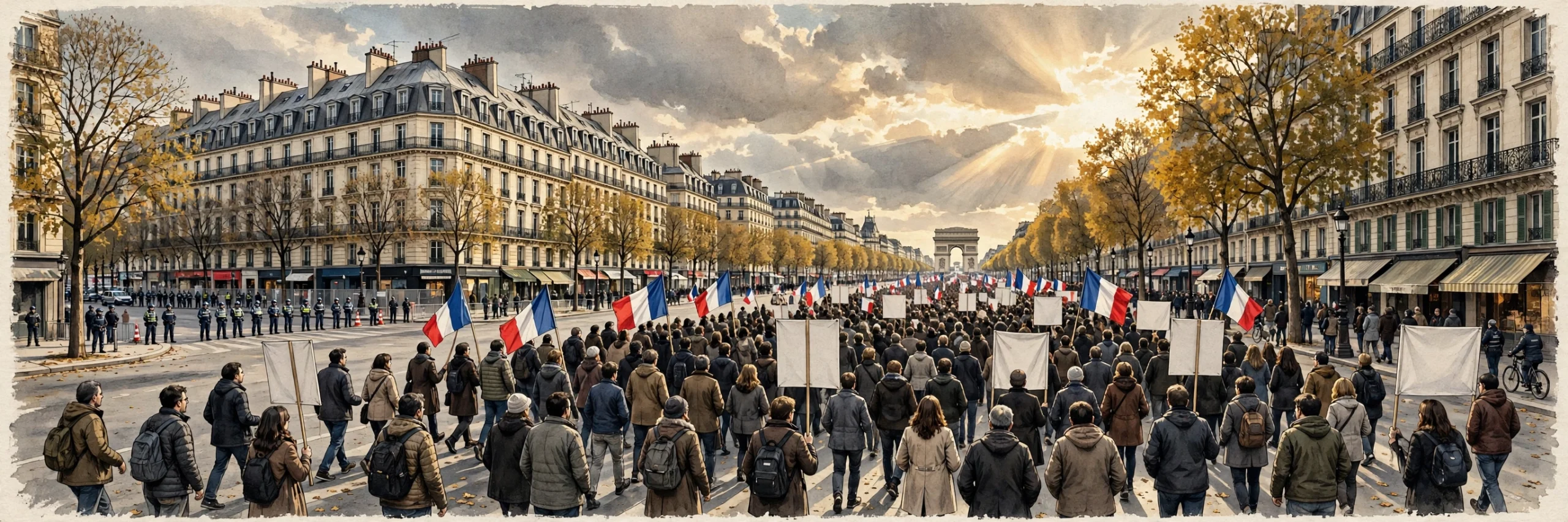
In Paris, the main march drew between 110,000 people, according to the government, and 250,000 according to organisers. For much of the afternoon the mood was festive, with families, brass bands and banners demanding action on household bills, wages and funding for schools.
Marches also took place in Marseille, Lyon, Bordeaux, Lille, Toulouse, Montpellier, Nantes and Strasbourg. Authorities had deployed 70,000 security forces across the country for the day, after violence marred the previous weekend’s protests.
The trigger for this round of unrest has been building for weeks. School pupils began protesting over teacher shortages and crumbling school buildings, and their demands widened into a broader challenge to President Emmanuel Macron’s government over living standards and public services.
Clashes at the end of the Paris march
Calm gave way to confrontation at the end of the Paris route, near Porte de Vincennes, where masked protesters threw bottles, stones and fireworks at officers. Police answered with tear gas, water cannon and sound grenades. Similar scenes played out in Marseille, where bins were set on fire and barricades built, and in Bordeaux, Lyon, Lille, Montpellier, Nantes and Toulouse.
Interior Minister Laurent Nuñez said nearly 1,000 people had been arrested by early evening, a provisional figure he expected to rise considerably. Two people were seriously injured, one in Toulouse and one in Clermont-Ferrand, the minister said.
Nuñez nevertheless described Saturday’s outcome as more “positive” than a week earlier, saying heavier police numbers, faster action and more pre-demonstration checks had better protected businesses. There was also widespread anger at the crackdown itself, which critics view as an assault on the right to protest.
A political crisis in Macron’s final months
The France protests October 2026 come at a sensitive moment. France goes to the polls in about six months to choose a successor to Macron after a decade in office, and the protests have deepened a political crisis in his final months.
Last weekend’s marches drew about 550,000 people by official estimates and ended with 2,700 arrests, looted shops and torched cars in Paris and other cities. Saturday’s marches were smaller by the official count but still enormous, and the gap between the government’s figures and the unions’ claims has itself become part of the argument.
Protests also swept other parts of Europe on Saturday, with tens of thousands marching in Italy, Spain, Portugal and Albania over pensions, housing costs, corruption and opposition to war — a sign that the pressures driving French streets are felt far beyond France.
For now, the government insists order was largely kept. The unions say the size of the crowds proves the public’s patience has run out. The next test will come with whatever the government offers on living costs — and whether the streets accept it nationwide.
Read More on Roz Khabar: