










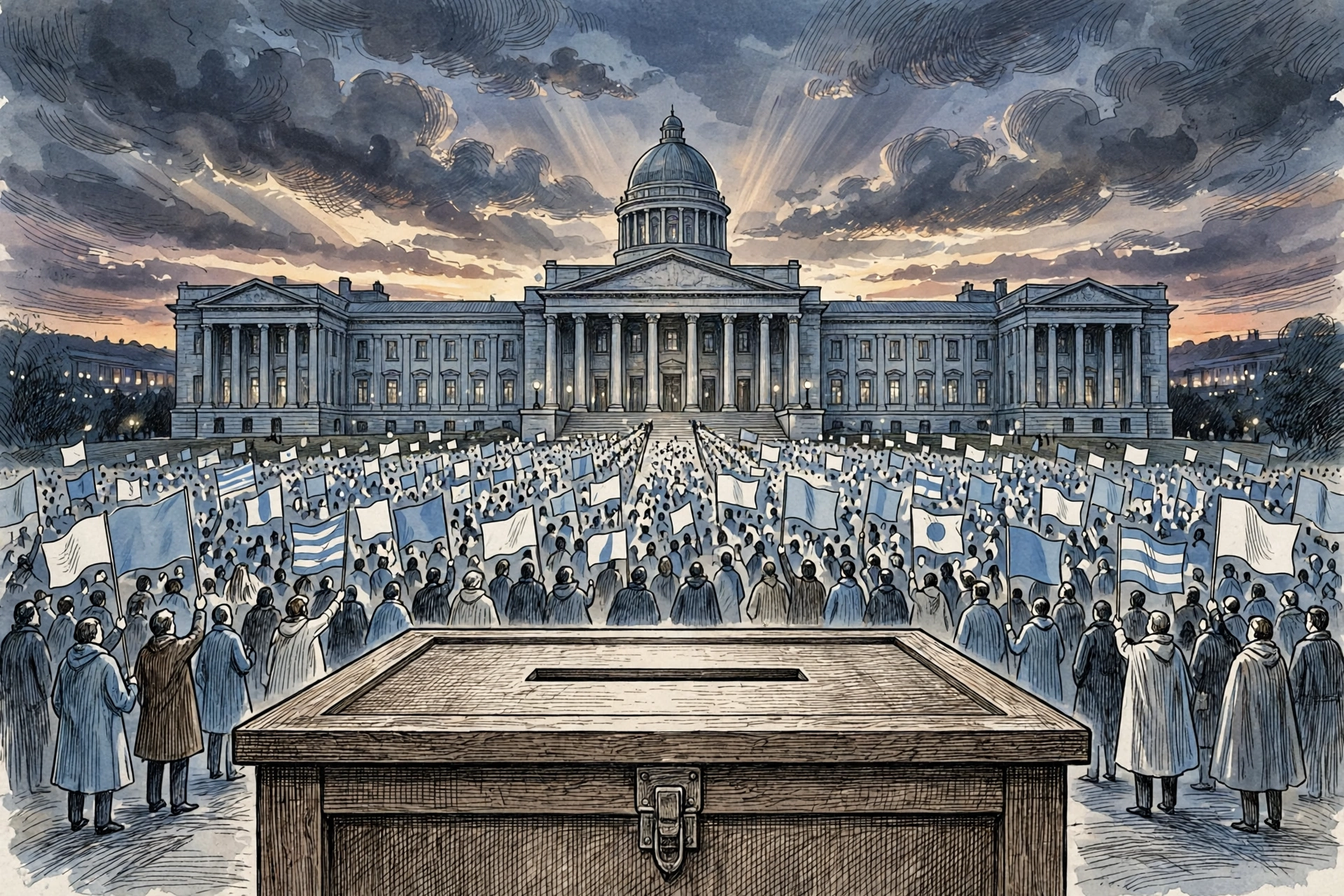
Israel woke on Wednesday morning to a parliament that belongs to nobody, and that, in its own unsettling way, was the clearest verdict the Israel election 2026 could have delivered, because after a campaign fought in the shadow of three years of war, voters turned out in numbers not seen for a generation and still handed neither camp the power to govern alone.
Both men at the centre of the contest claimed the momentum within hours of the polls closing, with Prime Minister Benjamin Netanyahu insisting his camp could still build a government and his challenger, the former military chief Gadi Eisenkot, telling supporters that a new era had begun, yet the arithmetic behind those rival speeches pointed in exactly the same direction, towards weeks of bargaining after the Israel election 2026 in a Knesset where sixty-one seats are the price of power and nobody holds them.
Table of Contents
Israel election 2026: a turnout surge that changed the mood but not the maths
The scale of participation in the Israel election 2026 was the first surprise of the night, since the Central Elections Committee recorded turnout at seventy-seven point seven percent when voting ended at ten in the evening, a jump of more than seven points on the comparable figure from the previous election four years earlier and, by the accounts carried in Israeli media, the strongest showing at that hour since nineteen ninety-nine, with around seven point three million citizens entitled to cast a ballot for the twenty-sixth Knesset.
That flood mattered because it was the first national vote since the Hamas attacks of October seventh, two thousand and twenty-three, and the wars that followed in Gaza, Lebanon and Iran, turning the contest into a referendum on wartime leadership that produced a louder stalemate rather than a winner.
Israel election 2026: exit polls that agreed on deadlock and little else
When the three main television channels published their projections at the close of voting, their headline agreed even as their details wobbled, since Channels eleven, twelve and thirteen each placed Netanyahu’s right-wing and religious bloc at roughly fifty seats, a steep fall from the sixty-four it commanded after the last election, while Eisenkot’s opposition bloc, built around his Yashar party alongside Bennett’s B’Yachad, Yisrael Beiteinu and the Democrats, landed somewhere between fifty-two and fifty-three, a lead without a majority and therefore a lead that governs nothing on its own.
As the night wore on the numbers shifted, with one update giving Netanyahu’s camp fifty-two against forty-nine and another showing a fifty-one apiece tie, a reminder that exit polls are estimates rather than counted ballots, while a strongly pro-Netanyahu channel stood apart with sixty for his bloc.
Beneath the bloc totals, Likud remained the largest single party with twenty-four or twenty-five seats, while Eisenkot’s Yashar followed on twenty-one to twenty-three, close enough to claim momentum and far from dominance.
The kingmakers in the middle and the threshold trap
The Israel election 2026 also produced consequential winners in the middle, since the Arab parties, the Joint List and Ra’am together, were projected to take seventeen or eighteen seats, up from ten last time, a bloc large enough to decide who governs and awkward enough that both camps have spent years ruling out reliance on it, with only the Democrats’ Yair Golan publicly open to such an arrangement.
Complicating the sums further, several smaller right-wing factions were shown hovering near the three point two five percent electoral threshold, the line below which a party wins nothing at all, so that as real ballots replace projections in the coming days, a party slipping under that bar could quietly hand seats to its rivals and redraw a map that already looks ungovernable, which is why seasoned observers in Jerusalem were warning on Wednesday that the exit polls were a snapshot, not a settlement.
What the Israel election 2026 deadlock really means
Strip away the victory speeches and the pattern is stark, because a prime minister who has led Israel for more than nineteen years in total has lost his majority without losing his position as head of the largest party, while a challenger promising a break with that era has gained ground without gaining the power to deliver it, and between them sits a parliament where the third force, the Arab parties, holds the balance yet remains politically untouchable to most of the people who would need its votes.
That is why the coming days matter more than election night, as Netanyahu holds his shrinking bloc together, Eisenkot tries to turn a narrow edge into a coalition, and the slow official count and presidential consultations still lie ahead.
For now, the Israel election 2026 will be remembered less for who won than for what it proved, which is that a record turnout, a wartime referendum and a challenger with real momentum were still not enough to break Israel’s great deadlock, and that the hardest question in Israeli politics, who can actually govern, remains unanswered the morning after the vote.
Source: Reuters coverage of the Israel election 2026 exit polls is available at Reuters: Netanyahu’s political survival on the line as Israel votes.
Read More on Roz Khabar: