









Spain woke on Thursday to a silence that felt heavier than any headline, because the Spain train crash that tore through a quiet stretch of railway near Urda the previous morning had left at least sixty-eight people dead, dozens more in hospital, and a country asking how two modern high-speed trains could collide on one of its busiest corridors, a question that now hangs over the three days of national mourning Prime Minister Pedro Sanchez has declared from October twenty-ninth to thirty-first.
The Spain train crash did not arrive as a distant statistic, since it unfolded just before nine in the morning, close to home for hundreds of ordinary travellers heading south from Madrid, and within hours the familiar rituals of grief were everywhere, from town halls holding a minute of silence at eight in the evening to football authorities postponing two dozen cup matches, while rescue teams were still picking through carriages that had slid down an embankment in the Toledo countryside.
Table of Contents
Spain train crash: what happened near Urda on Wednesday morning
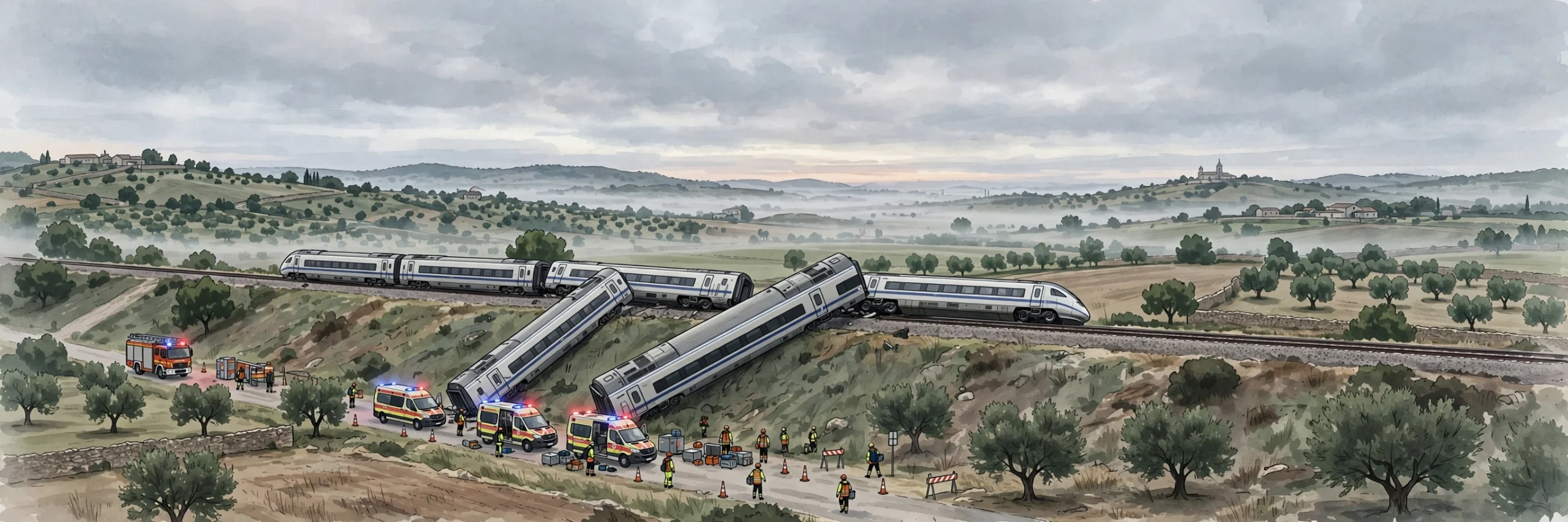
The collision took place at about eight fifty-three on Wednesday, October twenty-eighth, near Urda in the province of Toledo, on the high-speed line that links Madrid with Andalusia, and the sequence described by officials and carried by the Associated Press and Reuters is as stark as it is troubling, because a Renfe high-speed service running south struck the rear of a stationary Iryo train that was travelling the same way, derailing carriages from both trains and sending some of them tumbling from the track.
Five hundred and forty-four passengers were aboard the two services, with three hundred and ninety-seven on the Renfe train, the eight o’clock AVE 02080 from Madrid Atocha to Seville Santa Justa, and one hundred and forty-seven on the Iryo service 6076, which had left at seven fifty-four, and that crowded arithmetic helps explain why the casualty list grew so fast, from an early toll in the dozens to at least sixty-eight dead, with fifty-eight people receiving hospital treatment and rescue workers warning that the figure could still rise as wrecked carriages were moved and searched.
After the Spain train crash, rail services between Madrid and Andalusia were suspended after the impact, while the airline Iberia added more than five hundred extra domestic seats on routes from Madrid to Malaga and Seville to help stranded travellers, a practical response that only underlined how central this line is to daily life in southern Spain, carrying commuters, families and football supporters alike.
Spain train crash: the investigation and the questions it must answer
After the Spain train crash, Sanchez visited the crash site in Urda on Wednesday and promised a thorough inquiry, telling reporters that the country would get to the bottom of what happened and that, if negligence were found, it would be known, a pledge that carried extra weight because he also called it unacceptable for a country like Spain to suffer two major high-speed railway accidents within a single year, after the Adamuz crash in Cordoba in January killed forty-six people.
Transport Minister Oscar Puente pointed investigators towards a computer malfunction that, according to the Associated Press account, affected a safety system before a central command centre authorised the Renfe train to move again, a detail he described as part of an inexplicable decision, and while that early account is only a starting point rather than a verdict, it has already sharpened the focus on signalling, control-room procedures and the chain of authorisations that allowed one train to advance towards another standing on the same track.
Opposition leader Alberto Nunez Feijoo, while declining to discuss political accountability during the mourning period, demanded immediate government and judicial investigations carried out with all available resources and without interference, and called for a comprehensive, independent assessment of Spain’s railway infrastructure, a demand echoed on the streets, where around fifteen hundred people gathered outside the Transport Ministry to demand accountability for the dead.
What the Spain train crash means for rail safety in Europe
Beyond the grief, the Spain train crash matters because it strikes at a reputation Spain has built over decades, since its high-speed network is among the largest and most admired in the world, and a second fatal collision in nine months on the same Madrid to Andalusia corridor will inevitably force a harder conversation about whether expansion, automation and cost pressure have kept pace with safety culture, or whether familiar systems have been allowed to drift in ways that only become visible after disaster.
That conversation after the Spain train crash will not be settled by a single ministerial statement, because investigators must now reconstruct signalling data, voice recordings and maintenance records, compare the Urda sequence with the January accident at Adamuz to see whether the two share any cause or are tragically separate, and explain, in terms the public can trust, how a stationary train could be struck from behind on a modern line, and the credibility of that explanation will shape confidence in rail travel far beyond Spain’s borders.
For now, though, the Spain train crash is first a human story rather than a technical one, of families waiting for names, of towns holding silence together, and of a nation entering three days of mourning determined that the sixty-eight people who did not reach their destinations will not be reduced to a number in a safety report, but remembered as the reason the investigation must be complete, honest and unafraid of what it finds.
For further coverage of this story, see the BBC report: High-speed train crash kills at least 68 people in Spain.