







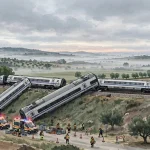



The Dnipro drone strike that tore through an ordinary Thursday morning in central Ukraine left at least fourteen people dead on a crowded railway platform, five more killed in daytime attacks on other cities, and one more dead in a late-evening missile strike on Kyiv, a day of bloodshed that arrived even as a fragile local truce in Kherson was raising cautious hopes that diplomacy might finally find a way back into a war now grinding through its fifth year.
That grim contrast defines the Dnipro drone strike, because while negotiators and mediators spoke of openings, families waiting for an everyday commuter train were caught in an explosion that scattered bodies across a shrapnel-marked platform, forced rescuers to fill black body bags beside pools of blood as air-raid sirens wailed, and reminded the world, in the starkest possible terms, that for civilians in Ukraine the war is not a distant negotiation but a daily lottery of sirens, shelters and departures that may never happen.
Table of Contents
Dnipro drone strike: what happened at the main station
The Dnipro drone strike centred on the city’s main railway station, where, according to the state railway company Ukrzaliznytsia, a jet-powered drone struck a platform on which a commuter train was standing, preparing to depart for the nearby city of Zaporizhzhia, and the timing could hardly have been crueller, since the platform was busy with passengers boarding and seeing off loved ones when the weapon arrived in the late morning.
Casualty figures from Ukrainian officials rose in stages through the day, with the regional administration first reporting thirteen dead and at least five wounded, then updating the toll to fourteen dead and fourteen injured, while President Volodymyr Zelensky, posting images of rescuers rushing the wounded away on stretchers, initially confirmed thirteen killed and ten injured before the count climbed, and officials warned that the numbers could still change as hospitals reported and wreckage was cleared.
Ukraine’s air force eastern command said Russia had sent four jet-powered attack drones towards the Dnipropetrovsk region at about ten in the morning Central European time, three of which were shot down, while the fourth found its target, and Ukrzaliznytsia added that evacuation announcements had played more than ten minutes before the impact, yet many people remained near the train, a detail that has already raised painful questions about how much warning is enough when sirens have become part of daily life and departure platforms feel, to weary travellers, almost normal.
Dnipro drone strike: a day of attacks across Ukraine
The Dnipro drone strike was not an isolated horror, because the same day brought five more deaths in daytime strikes on two other provincial cities and a further fatality when a late-evening missile hit Kyiv, taking the day’s known toll to at least twenty, and Ukraine’s prime minister, Sergiy Koretskyi, responded with a furious statement accusing Russia of deliberately hunting civilians on trains, at stations and in residential buildings, language that captured the anger of a country that has watched railway stations become targets before.
Zelensky, speaking in his nightly video address, condemned the attacks as cruel, and the Dnipro mayor, Borys Filatov, described the scene as a tragedy, noting that the drone had hit a civilian electric train, while the images the president shared, of bodies strewn across the ground and emergency workers sprinting between stretchers, travelled around the world within hours, becoming the defining pictures of a day that also, paradoxically, carried a glimmer of hope from Kherson, where a local truce had raised cautious expectations of a resumption of diplomacy.
That hope now looks painfully fragile, because the Dnipro drone strike landed just as talk of peace was gathering momentum, and Ukrainian officials will inevitably ask what kind of negotiation can proceed while commuter platforms are struck in daylight, a question that allies in Europe and Washington will also have to answer as they weigh further military aid, air defence supplies and the pressure they can bring to bear on Moscow.
What the Dnipro drone strike means for the war
Beyond the immediate grief, the Dnipro drone strike matters because it exposes the changing character of the conflict, in which jet-powered drones, faster and harder to intercept than their propeller-driven predecessors, are now reaching deep into cities far from the front line, turning railway stations, the arteries of civilian life, into front-line targets, and forcing Ukraine to stretch air defences that were already thin across an ever-longer list of places ordinary people cannot avoid.
For the families of Dnipro, though, the Dnipro drone strike is not a strategic case study but a morning that will not be forgotten, of a train that never left, of a platform that became a place of mourning, and of fourteen people whose only mistake was to be standing where millions of Ukrainians stand every day, waiting to go home, to work, or to see someone they love.
Read More on Roz Khabar: