









The Strait of Hormuz tankers that Iran says exploded and burned on Friday were sailing through the narrowest and most consequential stretch of water in the global oil trade, a corridor barely twenty miles wide at its tightest point through which roughly a fifth of the world’s petroleum normally flows, and the claims from Tehran, arriving in a drumbeat of statements across a single day, instantly raised the stakes in a conflict that has already turned this waterway into a front line.
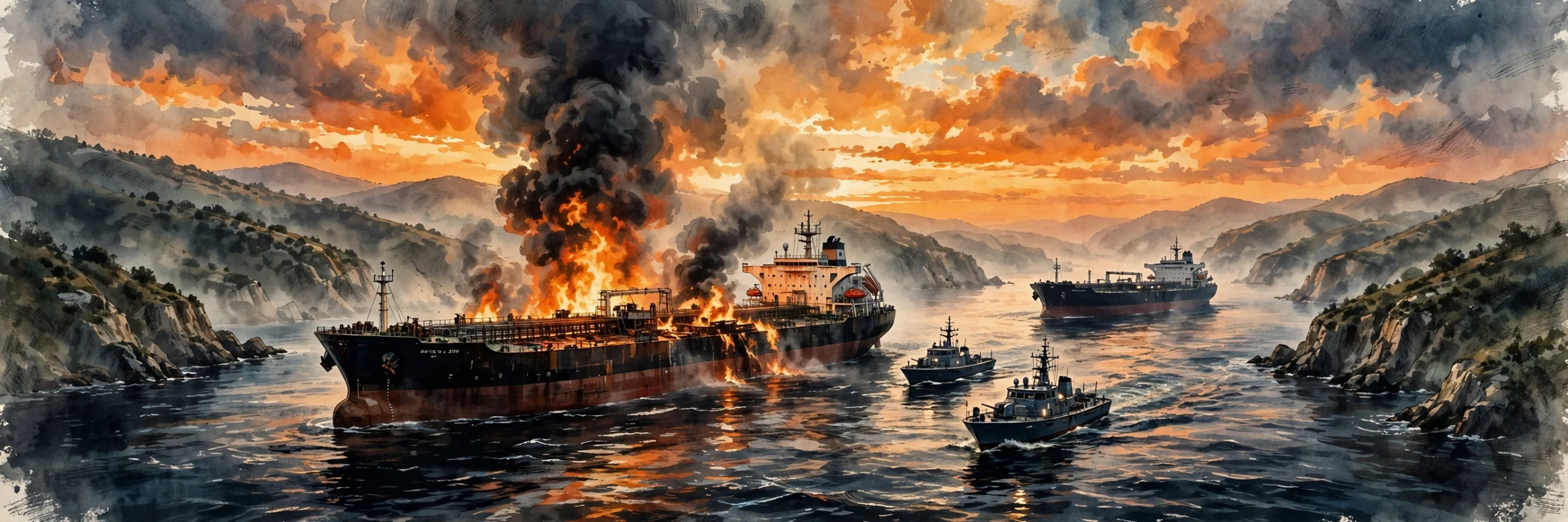
Iran’s Revolutionary Guards Navy said that four tankers had been hit in the Strait of Hormuz, with the most dramatic claim reserved for a supertanker carrying more than two million barrels of crude oil, which the Guards said struck a naval mine while travelling along a route Tehran calls unauthorised, suffered a powerful explosion, and was left burning, and the force added that the vessels had switched off their navigation and positioning systems and ignored repeated radio warnings before meeting their fate.
Table of Contents
What Iran Claims About the Strait of Hormuz Tankers
The Iranian account of the Strait of Hormuz tankers unfolded in stages, beginning with a statement that several vessels had struck mines on the southern route of the strait near the Omani coast, a corridor Tehran regards as off-limits, and continuing with later announcements that two more tankers had exploded and caught fire the same day, until the total claimed by the Guards reached four, although Iran did not name any of the ships, disclose their flags or countries of origin, or provide information about the fate of their crews, and Reuters reported that it could not immediately verify the statements.
That gap between claim and confirmation matters enormously, because the United States military pushed back directly against the Iranian version of events, with Central Command chief Brad Cooper saying in a video released on Friday that American forces had successfully cleared the strait’s internationally recognised primary transit routes of Iranian sea mines, a flat contradiction that leaves the world with two irreconcilable accounts of the same stretch of water on the same day.
Confirmed Incidents Behind the Strait of Hormuz Tankers Claims
Separate from Iran’s claims, maritime authorities did confirm real attacks on shipping that lend the Strait of Hormuz tankers story a verified and frightening core, because the United Kingdom Maritime Trade Operations agency, which collects reports from merchant shipping in the region, said a crude tanker was struck by an unknown projectile during an outbound transit of the strait, and in another incident a small boat attached two explosive devices to a tanker’s hull about twenty-five nautical miles north-east of Khasab in Oman, starting an engine-room fire that was later put out while the crew remained safe.
Maritime security sources named that second vessel as the Louise 1, a tanker flying the Panamanian flag, and Reuters described the limpet-mine style attack as the first successful use of sticky explosives in the waterway since the wider war between the United States, Israel and Iran erupted on February 28, a detail that suggests tactics in the strait are evolving even as the danger to crews grows more personal and more immediate.
Oman added its own confirmed rescue to the record on Friday, with the country’s Maritime Security Centre saying its navy had evacuated twenty-five sailors from a merchant ship set ablaze in an attack, a vessel the centre identified as the Panamanian-flagged RITI, which ship-tracking data describes as a crude oil tanker, and that rescue, carried out in open water while fires still burned, is the kind of fact that needs no spin from any capital to convey its urgency.
Why the Strait of Hormuz Tankers Story Moves Oil Markets
The Strait of Hormuz tankers drama cannot be separated from the war that has reshaped the region since late February, because Tehran has restricted maritime traffic through the strait ever since American and Israeli strikes opened that conflict, demanding that vessels use a designated route and coordinate their passage with Iran’s armed forces, while labelling the southern corridor closer to Oman’s shores as unauthorised, and ships that defy that demand now sail with the knowledge that someone, somewhere, may be watching them through a gunsight.
Analysts quoted by Reuters warned that continued kinetic action around the Strait of Hormuz, combined with doubts about any viable diplomatic path, is keeping oil prices elevated in expectation of an escalation in the coming weeks, and that market logic is brutally simple, since every tanker that burns or turns back tightens the world’s most important oil artery a little further.
Our own reading is that the Strait of Hormuz tankers episode should be treated with two disciplines at once, believing the confirmed rescues and agency reports while holding Iran’s unverified claims at arm’s length, because in a shooting war the first casualty is often the full truth, yet the sailors pulled from a burning ship off Oman are real, the fires reported by UKMTO are real, and the risk to the world’s oil supply, whatever the final accounting of Friday’s explosions, is real enough to watch closely in the days ahead.
Read More on Roz Khabar:
- North Korea Missile Launches: Around 10 Missiles Fired as Tensions Rise — https://rozkhabar.com/north-korea-missile-launches-october-2026/
- Dnipro Drone Strike: 14 Killed on Crowded Rail Platform in Ukraine — https://rozkhabar.com/dnipro-drone-strike-14-killed/
- Top Stories archive — https://rozkhabar.com/category/top-stories/
Sources: Reuters, Associated Press, UK Maritime Trade Operations notices, and Oman’s Maritime Security Centre statements on the Strait of Hormuz tankers incidents.