











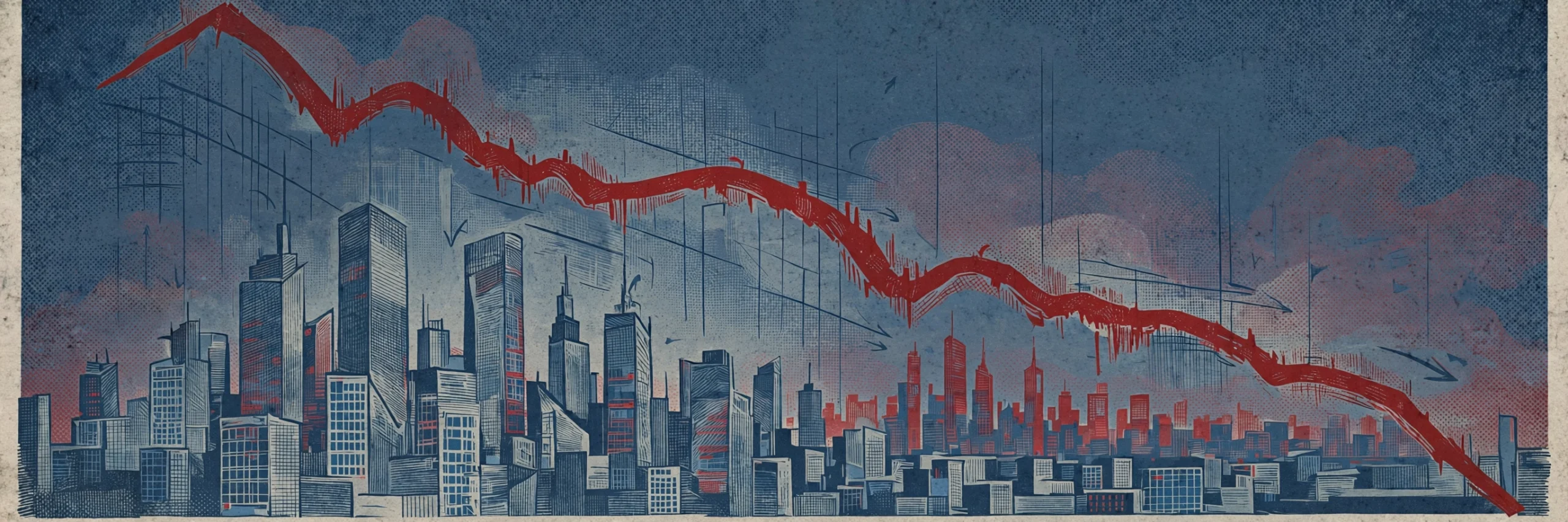
The Alphabet stock drop that rattled Wall Street on Thursday did not look like an ordinary bad day for a big technology company, because in a single session Google’s parent shed roughly five hundred billion dollars of market value, its shares fell by nearly thirteen percent in the steepest one-day decline since the company first listed in two thousand and four, and investors who had spent months cheering the artificial intelligence boom suddenly began asking whether the bill for that boom had finally come due.
That question now sits at the centre of the Alphabet stock drop, since the numbers behind it tell two stories at once, one of a business still growing at an impressive pace and another of a company spending so aggressively on data centres and AI models that its cash flow has turned negative for a second straight quarter, a combination that turned a merely disappointing earnings report into the second-largest one-day market value loss in American stock market history.
Table of Contents
Alphabet stock drop: what the earnings report actually showed
The Alphabet stock drop followed third-quarter results released after the market closed on Wednesday, October twenty-eighth, and the headline figures explain why traders reacted so sharply, because total revenue rose by a quarter from a year earlier to one hundred and twenty-seven point six billion dollars, yet still landed below the roughly one hundred and twenty-eight point two billion that analysts had expected, a miss of only about six hundred and forty million dollars that nonetheless landed like a much larger failure in a market priced for perfection.
Google Search, the engine room of the whole empire, grew by twelve percent to sixty-three point four billion dollars, a sharp slowdown from the seventeen percent growth recorded in the second quarter and below the sixty-four point nine six billion that forecasters had pencilled in, while total advertising revenue of eighty-two billion dollars also trailed the eighty-three point four billion estimate, and chief business officer Philipp Schindler pointed directly at AI Mode, the chatbot-style search interface that is now producing the fastest query growth in five years but earning noticeably less from each question than the traditional results it is replacing.
Elsewhere in the report the picture was brighter, with Google Cloud revenue more than doubling, jumping by one hundred and three percent to thirty point seven billion dollars from fifteen point two billion a year earlier, and operating income rising thirty percent to forty point six billion dollars, yet earnings per share fell to two dollars and twelve cents from two dollars and eighty-seven cents, partly because of an unrealised investment loss tied to SpaceX rather than any collapse in the core business, a nuance that did little to calm a market already nervous about spending.
Alphabet stock drop: the AI spending bill behind the sell-off
The deeper driver of the Alphabet stock drop was the spending column, where capital expenditure reached a record fifty-one point four billion dollars in just three months, more than double the twenty-four billion spent in the same quarter a year earlier and larger than the entire capital budget of many countries, while free cash flow slid to a negative nine point one billion dollars, far worse than the positive two point seven billion analysts had hoped for and the second consecutive quarter in which the company has burned cash.
Management refused to blink, keeping its full-year capital expenditure guidance at between one hundred and ninety-five and two hundred and five billion dollars, with chief financial officer Anat Ashkenazi warning that spending would rise significantly again in two thousand and twenty-seven, and filings revealed that procurement commitments, future leases and other obligations have now passed one trillion dollars, a figure that crystallised the fear driving the sell-off, namely that the AI race may demand ever-larger cheques long before it returns matching profits.
By the closing bell the damage was historic, with Class A shares finishing at two hundred and eighty-three dollars and eighty-two cents, down twelve point six four percent, and the Class C shares down twelve point two nine percent, while intraday estimates put the market value loss at about five hundred and eleven billion dollars, behind only chipmaker Nvidia’s five hundred and ninety-three billion dollar slide in January two thousand and twenty-five, and the wider market felt the tremor too, as the Nasdaq fell one point four percent and the communication services sector dropped six point six percent, its worst day since February two thousand and twenty-two.
What the Alphabet stock drop means for the AI boom
The Alphabet stock drop matters far beyond one company’s shareholders, because it is the clearest test yet of a belief that has carried markets for two years, the idea that almost any amount of AI spending is justified by the future it promises, and Thursday’s verdict suggested that investors are no longer willing to write blank cheques, demanding instead that the world’s most powerful technology companies show, quarter by quarter, that their enormous data centre bets are turning into revenue rather than simply into concrete, chips and electricity bills.
That shift does not mean the AI boom is over, since the cloud business is still doubling and search still generates tens of billions a quarter, but it does mean the conversation has changed, from how fast companies can build to how wisely they can spend, and rivals watching Alphabet’s punishment will know that their own earnings reports will now be read with the same unforgiving arithmetic, where a small revenue miss beside a giant spending figure can erase half a trillion dollars before lunch.
For now, the Alphabet stock drop stands as a warning written in red ink across the market, that even a company as dominant as Google can be humbled in a single session when growth slows at the edges, costs surge at the centre, and investors decide, all at once, that the future must start paying for itself, and the Alphabet stock drop will be watched, trade by trade, as the first real verdict on whether the AI boom can survive its own price tag.
Read More on Roz Khabar: