









The Europe protests that rolled across the continent on Saturday did not look like a single movement with a single slogan so much as a shared frustration finding different streets in different countries at the same time, because while hundreds of thousands of young French demonstrators marched for a third straight weekend over living costs and crumbling schools, their German counterparts filled more than thirty cities under the banner of a youth campaign, and thousands more gathered in Lisbon over a housing crisis that has priced a generation out of its own capital.
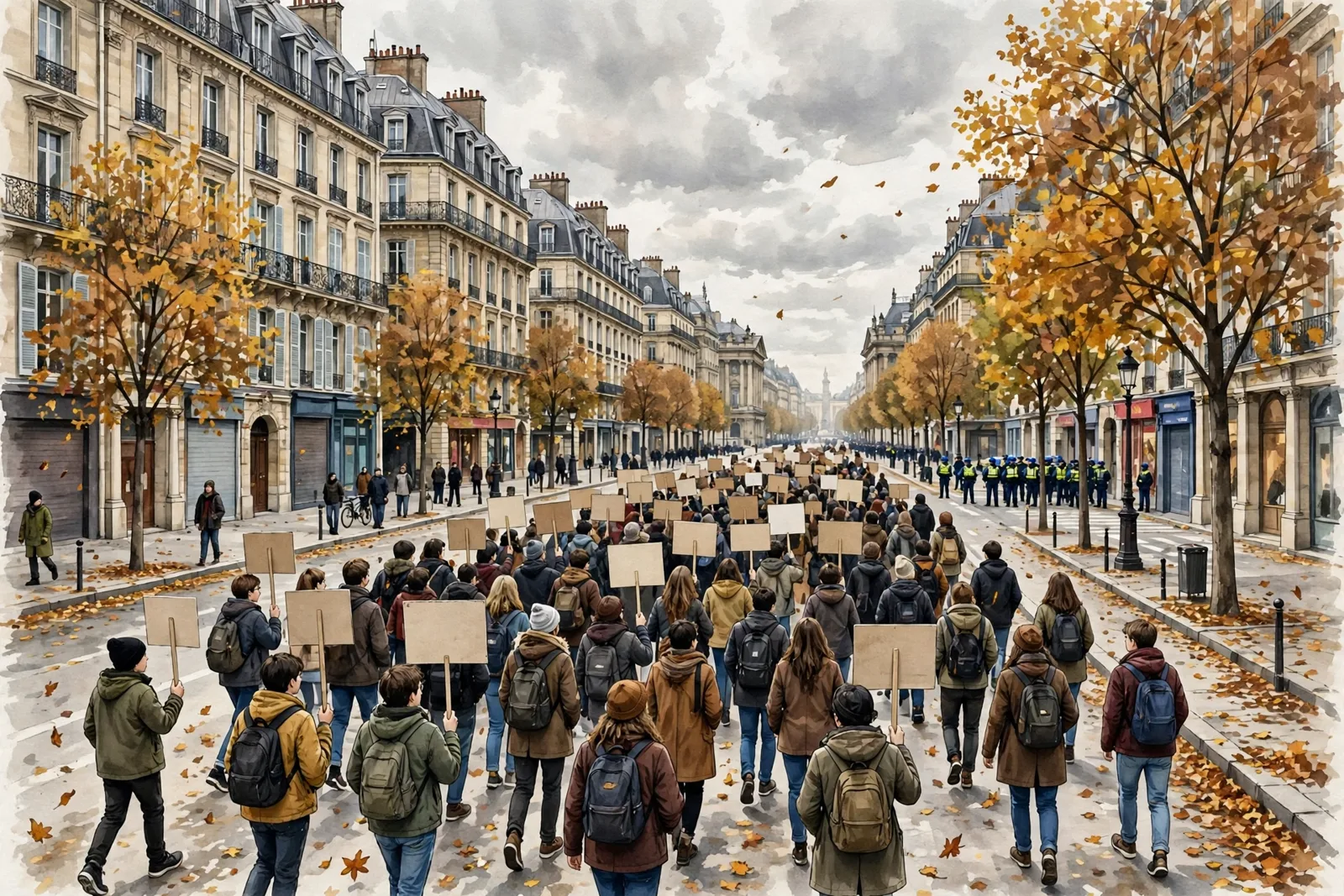
France remained the loudest centre of the Europe protests, with the Interior Ministry estimating that three hundred and twenty thousand people took to the streets nationwide, seventy thousand of them in Paris, a turnout that was smaller than the four hundred and ten thousand counted a week earlier and the five hundred and fifty thousand who marched on October 17, yet still enormous for a movement that began in school corridors rather than union halls, and authorities reported more than five hundred and sixty arrests by Saturday night as the day wore on.
Table of Contents
France’s Third Weekend of Europe Protests
The French chapter of the Europe protests has its roots in a high school student movement that erupted over neglected school buildings, chronic teacher shortages and a university admissions system that many young people consider rigged against disadvantaged students, grievances that have since widened into a broader revolt over the cost of living and public spending, and Saturday’s marches, though overwhelmingly peaceful and lightened in places by Halloween costumes, still ended in clouds of tear gas and scattered fires set by small groups on the margins of the main demonstrations.
Interior Minister Laurent Nuñez had warned before the weekend of a very high risk of disorder, particularly after dark on Halloween, and the government answered with around seventy thousand police officers and gendarmes deployed across the country, a show of force that kept most marches inside their declared routes but could not prevent the late-day clashes in Paris and other cities that have become a grim ritual of this protest season, with the Paris march itself moved outside the city centre after a last-minute court battle aimed at reducing the risk around government buildings and tourist sites.
Germany’s Gen Z Takes to the Streets
If France supplied the numbers, Germany supplied the sharpest images of the Europe protests, because the youth initiative calling itself Gen Z regelt, roughly translated as Gen Z’s got this, organised rallies in more than thirty cities demanding greater investment in education, health and climate protection, a more affordable everyday life, and an end to any return of military conscription, with organisers claiming tens of thousands of participants nationwide while official counts were still being tallied.
In Berlin, young protesters gathered at the Brandenburg Gate calling for more money for education and housing, but in Frankfurt the day turned ugly, with rioters smashing shop windows, looting stores and even stealing weapons from a gun shop, prompting police to deploy water cannons and special forces, and Hessian Interior Minister Roman Poseck blamed around one hundred violent left-wing extremists who he said had infiltrated the crowd and forced the demonstration to end early, a charge the organisers rejected as they distanced themselves from the violence and insisted their movement remained peaceful.
Barricades were also set alight in Hamburg, and the German organisers, undeterred, announced plans for further actions on November 20 as part of a Europe-wide movement, a signal that the Europe protests are not a one-weekend spasm but an attempt to build a lasting youth network across borders, with the grievances in each country rhyming even when the slogans differ.
Lisbon, The Hague and a Continent-Wide Mood
The Europe protests stretched beyond the two biggest stages on Saturday, because in Lisbon thousands of people, including families with small children, converged peacefully on the city centre to protest Portugal’s housing crisis, holding placards reading Houses or Fire and We are not Afraid, while in The Hague a heavy police presence guarded the downtown shopping area after online appeals for protests and fears of rioting and looting, though by mid-afternoon there had been no major disturbances in the Dutch city.
The wave also follows a general strike and mass rallies in Italy against rising living costs and defence spending, and the pattern across all of it is strikingly consistent, with young Europeans complaining that housing, education, healthcare and basic necessities have all become harder to afford at once, a squeeze that has turned what might once have been separate national arguments into a continental conversation carried on the same social networks.
Why These Europe Protests May Not Fade Quickly
What gives the Europe protests their staying power is that they are led, in large part, by people who have never known a time when housing felt attainable or public services felt well funded, and who are organising across borders with a fluency their parents’ protest movements never had, which means governments hoping the crowds will simply shrink away, as the French numbers have begun to do, may be misreading a movement that is learning, week by week, how to sustain itself.
The falling French turnout, from five hundred and fifty thousand to three hundred and twenty thousand in a fortnight, could equally be read as exhaustion or as consolidation, and the German organisers’ promise of a Europe-wide day of action on November 20 will be the next test of whether this generation’s anger hardens into a durable political force or dissolves into the winter, a question that now matters to every government in Europe. Whatever happens next, the Europe protests have already reshaped that debate.
Read More on Roz Khabar:
- France Protests October 2026: Nearly 1,000 Arrested as 410,000 March in Paris and Beyond
- US Midterm Early Voting Hits Record 47.9 Million Before Election Day
- World category archive
For Firstpost’s reporting on the rallies, see Firstpost’s coverage of the youth-led rallies sweeping Europe.